
Stock photograph: Scotch 27 glass-cloth roll with retail box.3M · 273M Glass Cloth Electrical Tape 27
Woven glass-cloth electrical tape for heat-stable insulation where mechanical strength, edge-tear resistance, and abrasion resistance matter.
Both are 3M high-temperature electrical tapes, but Scotch 27 is a 0.178 mm woven glass-cloth tape for heat-stable insulation at Class B 130°C, while Scotch 70 is a 0.30 mm self-fusing silicone rubber tape for cable joints and terminations at Class H 180°C.
| Selection point | 3M Glass Cloth Electrical Tape 27 | Scotch Silicone Rubber Splicing Tape 70 |
|---|---|---|
| Product type | Glass-cloth electrical tape | Self-fusing silicone rubber splicing tape |
| Backing | Woven glass cloth | Silicone rubber |
| Typical uses | Heat-stable insulation for furnace and oven controls, Motor leads and switches, Splices on heat-resistant wire | High-temperature cable joints and terminations, Splice overwrap on spacer cable at 15 kV and above, Primary insulation on silicone rubber cables |
| Source | Manufacturer data | Manufacturer data |
The two tapes solve heat in different ways. Scotch 27 is a woven glass-cloth tape with a thermosetting rubber adhesive, quoted at 0.178 mm (7 mil) for heat-stable insulation at Class B 130°C, with UL recognition to 150°C, for 600-volt dry applications. Scotch 70 is a self-fusing silicone rubber tape with no separate adhesive layer, quoted at 0.30 mm (12 mil) with a dielectric strength of 34 kV/mm, documented as a Class H material for continuous operation at 180°C.
Applications do not overlap much. Tape 27 insulates furnace and oven controls, motor leads, switches and splices on heat-resistant wire — assemblies where mechanical strength, edge-tear resistance and abrasion resistance matter. Tape 70 builds cable joints and terminations: 3M documents it as primary insulation on silicone rubber cables and as a splice overwrap on spacer cable operating at 15 kV and above. One is a flat insulating wrap for hot assemblies; the other is a stretched, fused build-up for a joint.
Roll format differs too. The stocked 27 roll is 19 mm × 20.1 m; the standard 70 roll is 25 mm × 9.1 m. The 70 wrap is applied under tension so the layers fuse into a continuous layer, so the wrap tension and layer build matter as much as the model; 27 is applied as a conventional adhesive tape. Confirm the assembly and the installation procedure before selecting either.
Neither tape is a substitute for the other. Start from the service temperature and the assembly — a hot control or motor lead, or a cable joint or termination — then confirm width, roll length and quantity against the 3M data sheet before requesting a quotation.
Woven glass-cloth electrical tape for heat-stable insulation where mechanical strength, edge-tear resistance, and abrasion resistance matter.
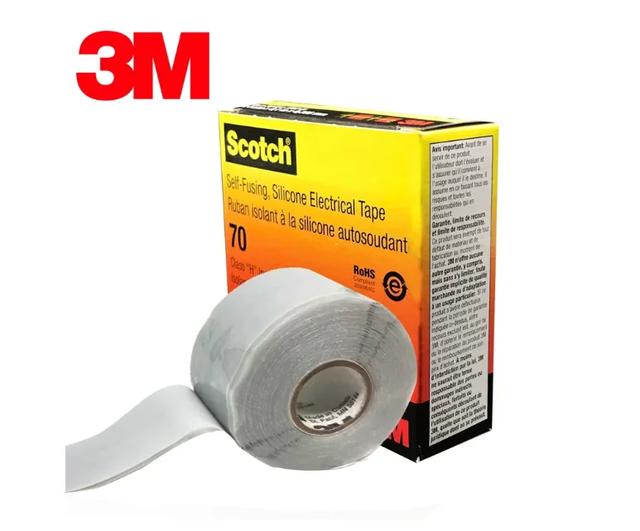
Self-fusing silicone rubber splicing tape for high-temperature cable joints and terminations where Class H (180°C) insulation is required.